- Ukraine claimed in November that one of its snipers killed a Russian soldier 1.68 miles away.
- That could make it the second-longest sniper kill of all time.
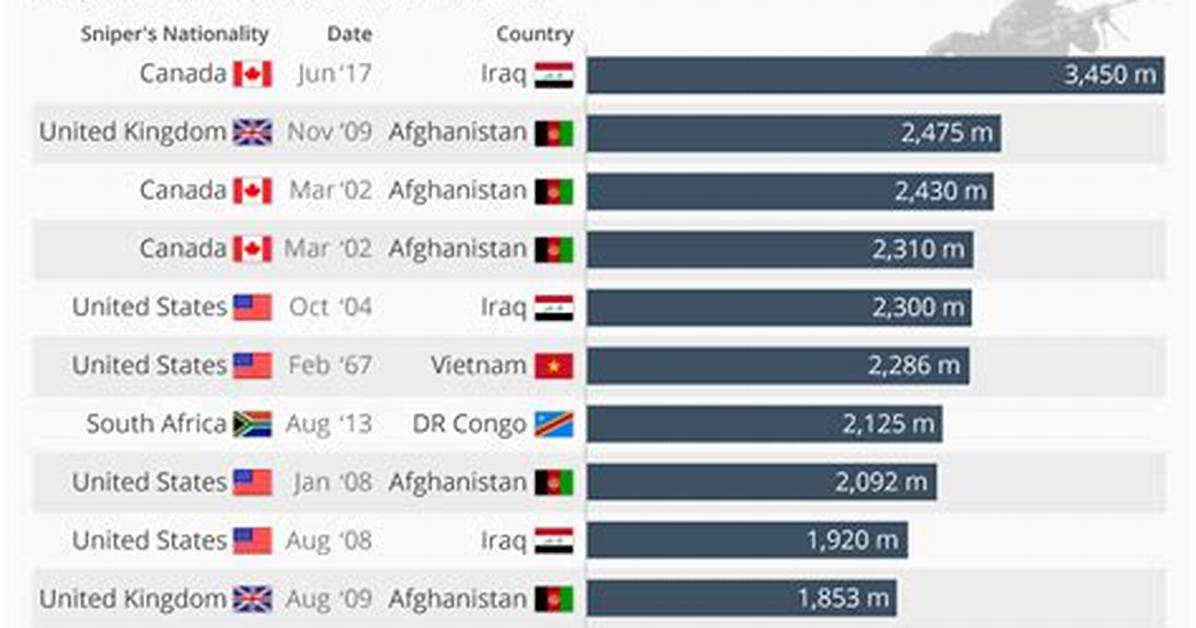
- There's no universally verified list of the longest-ever kills, but here are some of the contenders.
In November 2022, Ukraine claimed one of its snipers shot a Russian soldier from around 1.68 miles away, which could make it the second-longest sniper kill of all time.
There is no verified list of the longest sniper kills, perhaps not surprising given the circumstances in which they take place. It is possible that kills have taken place which should be on this list but were never reported publicly.
Insider's list compiles reputable accounts published elsewhere and puts them in order to give a sense of how the best snipers in the world have performed on the battlefield.
9. Specialist Nicholas Ranstad (US Army) — 1.28 miles
Ranstad was operating in a part of Kunar province, northeastern Afghanistan, where he used a boulder for target practice. He would take notes on different variables affecting his shots — such as the temperature and wind — after each one, the New York Post reported.
In January 2008, Ranstad spotted four enemy soldiers stood conveniently by the rock, the Post said. After missing with his first attempt, Ranstad hit one of the insurgents with his second shot, despite them being outside the range of his gun's scope, per the report.
8. Unnamed South African soldier — 1.32 miles
The soldier was deployed as part of a South African UN squad fighting rebels in the Democratic Republic of the Congo, according to South Africa's TimesLIVE news website.
The soldier killed six enemy officers during the Battle of Kibati in August 2013, the report said. One of the shots was said to be from 1.32 miles away.

